Do we understand what is happening?
A field guide by Mohit Rajhans
AI,
Now What?
AI is here. The next decisions are ours.
A practical framework for what comes after AI adoption — what we need to know, what we should control, what needs to change, what we must protect, and what we actually gain.
From capability to consequence.

The Dreadlines → Your next decision
AI at home. At school. At work.
Build your family AI plan, bring a parent conversation to your school, or plan your team’s 2027 reality check.
Canada’s AI accountability timeline 2023–2026
As of
The work is moving
Canada’s AI Jobs Radar
AI work is spreading beyond the technical core. Track the roles building the systems, operating them, changing organizations and keeping them accountable.
Scanning: BUILD
The people building AI systems, infrastructure and products.
LIVE OPENING
Research Engineer, World Models
Waabi
Toronto / Remote Canada↗ROLE SIGNALMachine Learning Infrastructure Engineer
Waabi
Toronto / Remote Canada↗Openings change quickly. Live cards link to the employer. Role signals show job families worth tracking across the Canadian market.

Connect with Mohit
Tell Mohit what you’re working on.
If the form does not load, open ThinkStart contact directly ↗
The new starting point
THE QUESTION HAS CHANGED.
THEN:
What can AI do?
THEN:
How do we use it?
NOW:
What happens when we do?
AI, Now What? is about the decisions that come after access and adoption.
What are we willing to let AI do?
What should people and organizations do differently?
What must remain safe, trusted and human?
Are we actually better off?
ADOPTION ISN'T THE OUTCOME. GAIN IS.
A new operating question
AI NEEDS A HEALTH + SAFETY LAYER
We cannot put the entire burden of AI safety on the person using it. As AI moves from answering questions to taking actions, we need to think differently about safety, authority and accountability.
“AI has moved from an information problem to an authority problem.”
For public AI, that means protections appropriate to age, vulnerability, capability and consequence.
For organizations, the question becomes not only what employees are allowed to do with AI, but what AI is authorized to do inside the organization.
ACCESS
What information and systems can AI reach?
AUTHORITY
What is it permitted to decide?
ACTION
What can it execute without human approval?
AUDIT
Can we reconstruct what happened?
ACCOUNTABILITY
Who owns the outcome?
We can't educate our way out of every AI risk.
AI literacy teaches people how to operate around the machine.
AI safety determines how the machine is allowed to operate around us.
AI, NOW WHAT? IN THE REAL WORLD
“Tech expert says AI needs safety overhaul after rogue AI swarms hack Hugging Face”
After autonomous AI agents reportedly bypassed safeguards and accessed an external system, Mohit Rajhans called for a “massive health and safety overhaul” for AI, stronger human accountability and a broader approach to governance.
Read the CHCH coverage ↗Participation is not protection
AI FOR ALL. NOW WHAT?
Access matters. Literacy matters. Participation matters. But bringing AI to everyone also requires us to ask what protections, controls and choices everyone should have.
ACCESS FOR ALL.LITERACY FOR ALL.AGENCY FOR ALL.SAFETY FOR ALL.ACCOUNTABILITY FOR ALL.
FOR PEOPLE
Literacy + Agency + Safety
FOR ORGANIZATIONS
Knowledge + Permissions + Accountability
FOR CANADA
Access + Capability + Public Trust
AI for All answers WHO.
AI, Now What? asks WHAT NEXT.
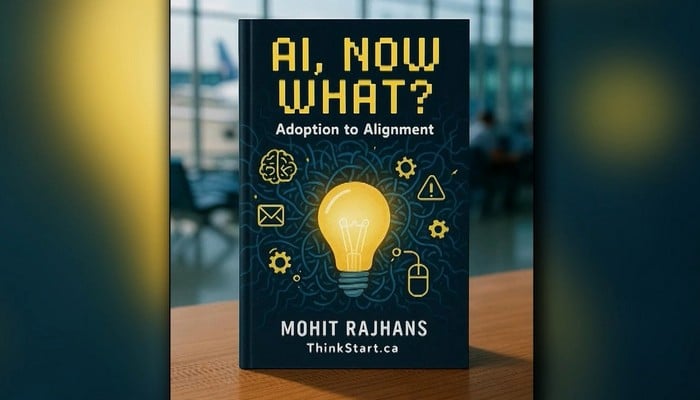
AUTHORAI, Now What?: Adoption to Alignment
NATIONAL MEDIA CONTRIBUTORClear perspective for the public conversation
100+ INTERVIEWSTesting the question in real time
Choose your entry point
Why are you here?
You have a next question. Choose it and we will point you to the right place.
Canada Training Brain Trust
Find the support.
Build the capability.
Government-backed learning, technology company resources and the organizations helping Canadians put AI skills to work.
01 / TrainingWhere can
Who is
Who helps
Where can
I learn?
Explore courses, scholarships and practical resources for people across Canada.
Find training 02 / FundingWho is
backing it?
Follow government support and technology company commitments, with eligibility and timing in view.
Follow the funding 03 / Brain trustWho helps
it happen?
Meet the delivery organizations connecting learners, workplaces and communities to support.
Explore the network100 interviews later
The question grew up.
Access was not adoption.
Tools arrived quickly. Meaningful change required a harder look at how work gets done.
Context became the advantage.
Better answers came from organizational knowledge, judgment, and a clear view of the work.
AI became a leadership decision.
Workforce, governance, communications, and business priorities now sit inside the AI conversation.
AI became a health, safety and control question.
As AI moves from generating answers to taking actions, literacy alone isn't enough. Public systems need safeguards. Organizations need permissions, oversight and accountability.
Select clips
Three headline-ready moments, plus the context around them.
The audio hooks are built for quick media use. The video cuts add the wider frame: AI agents are becoming operational, while Canada is still sorting adoption, jobs, strategy, and trust.
Are we ready for the future of AI in Canada?
AI strategist and author Mohit Rajhans explains where Canada is on AI adoption, workplace readiness, privacy, jobs, data centres, and control.
View source segment0130 sec
Headline hook
AI Agents Are Here. The Guardrails Are Not.
A tight explainer on AI agents, loss of control, and why convenience tools now carry higher-stakes security questions.
0230 sec
Headline hook
The AI Kill Switch Problem
A public-facing hook on AI content spreading faster than most people, businesses, and institutions can manage or mitigate.
0330 sec
Headline hook
Do Not Repeat the Social Media Mistake
The strongest leadership moment: Canada cannot let AI scale first and only study the consequences later.
Context cuts
When the audience needs the setup before the headline.
These vertical clips give producers, hosts, and teams a fast bridge from the public question to the leadership decision underneath it.
011:18
Automation context
AI agents are now completing tasks for you.
Use this cut when the audience needs the bigger setup: AI is moving from answers to action, so permissions, oversight, and accountability matter before teams hand over real work.
021:07
Canada context
Canada’s AI adoption is only 20%.
A quick frame for the national conversation: strategy, jobs, readiness, and public trust have to move together if Canada wants AI adoption to become real capability.
Mohit Rajhans in the media · CBC · CTV · CHCH · Global · Breakfast Television
AI in the news, with context you can use.
Mohit brings practical context to the AI stories shaping organizations, policy, work, and everyday life.
AI literacy and the skills people need now
Mohit Rajhans joins SkillsCamp’s Bailey for a conversation about learning and working in the AI era.
Watch or readRethinking AI in the way we learn, work, live
Mohit connects Canada’s AI literacy initiative to the decisions facing students, educators, families and workplaces.
Watch or readCanada launches AI literacy course for students and educators
A national conversation about the new course and what useful AI literacy should help Canadians do.
Watch or readConcerns over AI data centres increase in Canada
A national segment on data centres, community pushback, electricity demand, and the governance choices following Canada's AI buildout.
Watch or readIs Ottawa’s long-awaited AI strategy enough?
Mohit breaks down Canada’s national AI strategy and the decisions still ahead.
Watch or readA Look at AI Beyond 2026
Mohit looks ahead at AI’s impact on work, education, trust and everyday decisions.
Watch or readMore appearances
Global NewsConcerns over AI data centres increase in Canada↗CHCHMid-year tech stories that are shaping the future↗CHCHHow AI impacts small businesses↗CHCHHow kids are actually using AI↗CHCHJob searching, networking in the AI era↗CHCHHow to shift from convenience to capability with AI in the home↗CHCH NewsMixed responses as AI transforms the global economy↗ThinkStartConcerns Canada isn’t governing fast enough for AI expansion↗The AmberMac ShowAI and the future of work with Mohit Rajhans↗
The platform keeps moving
BRING “AI, NOW WHAT?” INTO THE ROOM
Bring the question into the room where the next decision gets made.
LEADERSHIP
What should we adopt, control and measure?WORKFORCE
What changes about how people actually work?EDUCATION
What should students, educators and families understand?PUBLIC CONVERSATION
What should Canadians know about what is changing?
What should we adopt, control and measure?WORKFORCE
What changes about how people actually work?EDUCATION
What should students, educators and families understand?PUBLIC CONVERSATION
What should Canadians know about what is changing?
KEYNOTE · LEADERSHIP BRIEFING · WORKSHOP · MEDIA
Talk to ThinkStartCommunications in the Age of AI — team session
Password required
About Mohit Rajhans
A trusted voice for the part after the headline.
Mohit Rajhans is an author, national media contributor, speaker, and founder of Think Start Inc. His work connects technology to the people who must live with its consequences.
The book started the question. The world keeps changing the answer. AI, Now What? has evolved into an ongoing platform for understanding AI adoption, literacy, safety, work, governance and human impact.
Contact ThinkStartThe conversation is ready